Friday, September 24, 2010

And my Very Green Soap

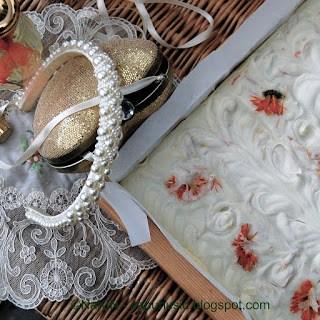
That metal circle will be a great frame for a wedding picture
of the kids. I have just the right photo for it but need to
 photoshop it to fit. I also dried some of my Hollyhock.
I actually intended to try to make another blue soap with indigo be cause the first one was a total failure.  I had put the indigo powder into oils and it did not give any colour.  So I figured that I should put it into the water, so I tried that.  Well, that sure didn't work either so I changed direction and reached for my dried herbs in the hope that I would be able to make green soap.

I chose Comfrey, since I have quite a bit of it already dried and still a lot left in the allotment garden.  I think maybe I read that Cocobong has used that and gotten a good green, but I'm not sure, it might have been nettle.  I know that I have read that Parsley is supposed to give a good green.  I tried to put that into oil.  Do not do that.  It's completely pointless.  So now I'm drying some and I will try to put that into the water for a soap sometime.

But back to Comfrey.  I have some of that in oil and also some that I simply dried.  Since the infused oil isn't particularly green I put some crushed dried leaves into the lye water and let it sit for a while and it did turn a bit green, but not a lot.  So I decided that I would leave the leaves in and attempt to make them smaller with the stick blender.  Which I did and it worked fine.  I don't usually like to leave flecks in the soap if I can help it, but if I hadn't there wouldn't have been much colour at all.

Since I had just bought some patchouli EO I decided to use that for the first  time along with some Bergamot and Lemongras EO's.  I have to admit that I wasn't sure what Patchouli was like because I have never had it.  It is very Hippy to me.  Reminiscent of the seventies.  Which is good.  A bit masculine also, and that is good since I haven't done a masculine fragrance in a long time.

I did a very simple soap.

Coconut oil 30%  150 g / 5.3 oz

Olive oil 40%       200 g / 7 oz
Soybean oil 25%  125 g/ 4.4 oz
Cocoa butter 6%    30 g / 1 oz

Water  38%          190g / 6.8 oz
Lye                        72g / 2.5 oz
5% SF.

So the soap wasn't particularly green at first, but when I cut it it was this beautiful grass green.  Alas, it has now turned olive green.  A nice olive, but that green was amazing.  How I miss it!  But these are perfect soaps to give as a gift to a few guys that I have been working with.  There are a few women in that group also, so I now am thinking up a recipe for a pink soap using my Rumex oil for the colour.
.

Saturday, September 18, 2010

My Incredibly Green Cream

I had dried herbs hanging all over the house in the autumn
and I am always looking out for suitable containers for dried
herbs, face creams, body lotions, lip balms and toners.
I have been making face creams for almost two years now. I really like that and I use no commercially made creams anymore.  In fact, my cousin and I were talking and she was telling me how someone had given her a sample of a well known brand of face cream and she almost threw up because it smelled so artificial.  I so agree.  All those famous brand creams now are about as appealing to me as nuclear waste.

The creams I make are usually made with beeswax as an emulsifier.  That makes a thick, very creamy and slightly oily cream that is very good for the night.  It is concentrated and a little goes a long way.  I tend to slather on lots and lots, probably I use too much, and I really shine in bed at night.  But I have been searching for a lighter emulsifier as an option for daytime.  I ordered some vegetable emulsifier and it came with an ingredients label that said: Sodium Lauryl Sulfate!  That is very irritating to the skin and it is one of the ingredients that I want to avoid.  So I haven't used it at all.

I was really please to read Texia's (at Sanga natural) post about homemade emulsifiers.  She did two recipes and I have made them both and already used one in a cream.  I have a lot of dried herbs and herbs macerated in oil and I figured that I should use all my herbal oils for something.  So I decided to make an incredibly green cream.

The Incredibly Green Cream:

Oil phase - 70g of macerated oils: 20 g. each yarrow (Achillea) oil, chickweed (Stellaria) oil and Calendua oil.  10 g. mock orange (Philadelphus) oil.  And additionally almost 1 tsp. Njóli (Rumex) oil.
Into the oil I added a pinch and a dash of AHA and A retinol.  I don't have a scale that measures accurately in small increments so I eyeball the small stuff.

Water phase - 120 g. herbal tea: I made tea with the following herbs: Yarrow (Achillea), chickweed (Stellaria), shepherd's purse (Capsella), Comfrey and Viola.  I let this steep for about an hour and then I added a bit of licorice extract and niacin as well as the preservative Natrium benzoat.

Making cream is just like making soap, minus the lye.  I warm the ingredients in bain marie and then pour the water phase into the oil while whisking with a stick blender.
I forgot to write how much emulsifier I used, but I think it was somewhere between 10 and 20 g. and I put it into the water phase.

I like the cream very much, so thank you Texia.  I've been using it for about 2 weeks now, both morning and night.  It absorbs well so that my husband's goodnight kiss doesn't slide right off.  It is chock full of goodies for the skin and smells a bit green and I am pretty sure that it has taken twenty years of my appearance already.
.

Sunday, September 12, 2010

Calendula soap - Triple luxury

That improvised soap mold worked beautifully and I could
easily use it to practice swirls. The heart shaped evening bag
is pretty and the ornate hairband is a little over the top.
Now I know that it's fall again.  My cousin and I just started to make soaps together again after taking the summer off for the most part even though I have made a few soaps on my own.  I can't not do it.  I guess it's an obsession of sorts, or it's just too much fun to not do it.  And there always seem to be some really fund things to try out.

But our joint soap making sessions are ususally fun.  We always manage to agree on what to do and this time she wanted to make calendula soap with her homemade Calendula oil and my dried Calendula petals and her dried flowerheads.  We ended up making it in a tray mold that I had picked up at "The Good Shepherd" a thrift shop charity where I spend all my spare cash.  It isn't really a soap mold, that much I know, but I can't imagine what else it could be used for.  I frequently get asked by the staff at the till: "What is that you are buying?" and very often the answer is: "I have absolutely no idea".  I usually figure it out or find some use for the stuff myself at some point.  But back to soaps.

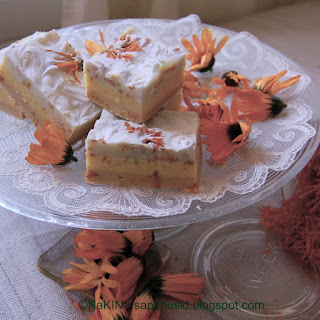
Very pretty and very nice soap for delicate skin.
We intended to make just one recipe and since we wanted it a bit yellow we used carrot juice and we also hoped that the infused Calendual oil would contribute a bit of colour.  But as it turned out we made a 3 layer soap because the mold required at least 3 pounds of soap and we just made a regular size batch the first time.  So we made the other two a bit different, just for fun.  We could have made swirls, but didn't since she wanted to put dried flowers on top and I have to admit that that looks very nice.

I was asked for cut pictures and here they are, the little hacked up darlings.  It did surprise me that the dried calendula petals came through with their colour so orange, but I don't know if that will last.  We used no fragrance.  Two reasons for that.  I placed an order from a UK company at the beginning of June and am still waiting for it!  This might turn into a separate post about fraud pretty soon.  I've called and emailed... But... later.  Anyway, in the absence of the EO's that we should have received a looong time ago we thought we would make this unscented and therefore suitable for people with allergies and sensitivity to fragrance.

The recipes are:

Layer 1:
Olive oil            56%        420 g / 14.8 oz
Coconut oil       28%        210 g / 7.4 oz
Cocoa butter       6.3%       70 g / 2.5 oz
Sunflower oil      5%          50 g / 1.8 oz (Calendula officinalis infused)

Carrot juice         38%       285g / 10 oz
Lye                                    103g / 3.6 oz
8% SF.

The infused oil was added at trace as well as a generous amount of dried Calendula petals.  This layer turned out to be a slightly yellowish tan colour.

The next layer is almost the same except we added unrefined palm oil which I found in an Asian store and couldn't resist trying even if there are all kinds of ethical issues.  So layer one has different percentages, but mostly the same numbers are layer 1.

Layer 2:
Olive oil                   52.5%      420 g / 14.8 oz

Coconut oil              26.3%      210 g / 7.4 oz
Cocoa butter               8.75%       70 g / 2.5 oz
Sunflower oil              6.25%       50 g / 1.8 oz (Calendula officinalis infused)
Unrefined Palm oil     6.25%       50 g / 1.8 oz 

Water        38%       304g / 10.7 oz
Lye                         109g / 3.9 oz
8% SF.

To this we also added dried calendula petals and the infused oil went in at trace.  This layer turned out a very pretty yellow.

The third layer was the same as the first except we used water instead of carrot juice.  That layer is quite white and is a perfect backdrop for the dried flower heads we pushed in on top for decoration.

Cutting the soap turned out to be a bit of a challenge.  I hadn't really thought about how I would do that since the mould is larger than any knife I have.  I guess I need to make a wire cutter if I use that mould again.  I had thought that we would end up with 3x4 soaps out of the mould, but when I had cut (hacked?) them up they were way too big so I cut them in half again.  And they look kind of cute, if a bit crooked.
.

Saturday, September 4, 2010

My bad - Salt soap

Etageres are irresistible to me.  This one is new, but looks
old. It was an impulse buy, but looks good in the sunroom,
filled with whatever little trinkets that needs a home.
Feeling a bit blue and bored the other day, I had the idea to make a blue soap.  I have some indigo and have read that it will make a blue soap.  Salt soap, I thought, would look nice in blue.

Feeling quite a bit less blue,  I took out the bag of the coarse sea salt that I picked up the other day and happily pulled out my oils.  I made a pretty simple recipe, but there was nothing pretty about the outcome.  It didn't have a trace of blue and it was just pure ugly.  But it smells nice, still.   Don't know if it will last.

There is something really sad about ugly soaps.  Soaps should be pretty.   This soap is very ugly.  Even more so than the photo suggests.  I sometimes try to like my ugly soaps.  Try to think of them as ugly ducklings that will turn into beautiful swans.  Sometimes they actually do.  Some of them turn out to have a great lather or smell or feel on the skin and end up as my personal favorite in the bath.  But some are just ugly soaps and there is nothing to be done, but rebatch.  I don't even know if it is possible to rebatch salt soap!

Appart from the failure to turn blue, nothing much went wrong, perhaps I just don't like the coarse salt.  It doesn't have a good feel to it.  Crumbly and difficult.  I need to try it out in the bath to see what it's like.

The recipe was a rather uninspired 30% coconut oil, 25% lard, 20% olive oil, 15% cocoa butter and 10% sunflower.  I put the salt into the soap at trace at the ration 1:1.  The fragrance I used was lemongrass, bergamot and peppermint.  At least it smells nice.  I need to find out more about indigo in soap.  This obviously didn't work.  But what the heck!  Chuck it up to experience.
.

Wednesday, September 1, 2010

Mock orange / Philadephus coronarius - oil infusion

My mother gave me that colander and I use it for all sorts of
things. It's perfect to separate the stamens from the petals.
I have two Philadelphus bushes in my garden.  They are on either side so when I walk into the garden when they are in bloom, the air is filled with this magical fragrance that is so different from any other.  To me it is like the scent of oxygen, if it had any.  Just so refreshing and light and a hint of vanilla.  I have often thought about trying to capture the fragrance somehow and the scent is so unusual.  So this year I decided to collect the flowers and pour oil over them to see what happened.  I have done this with roses and viola, but one of the dogs got into that jar and licked it up!

It is time consuming to collect enough quantity, but I was in the company of eager bees and it was nice and sunny.  The bushes were absolutely covered in flowers so they still looked pretty after I had raided them.  I then tried to isolate the petals from the stamens (the things in the middle of the flowers) and was successful using the old Swedish colander that my mum gave me and shaking it.  Then I put the petals in a jar and poured oil over.  This I let sit for only 24 hours during which I try to poke the petals into the oil.  They tend to float up.  I find that longer time does not work well with Philadelphus petals, they wilt quickly and start to look bad.  When that happens there is no fragrance left in them.  So I strain them out and let the oil sit for a bit.  There are always some impurities and bits that gather at the bottom.  These are water based and and heavier than the oil so they sink to the bottom.  When the oil looks completely clear I pour it into another container.  A turkey baster also works well.

I managed to make two infusions, one with Apricot kernel oil and one with almond oil.  I infused the first 3 times and the second 2 times.  The fragrance that was left in the oil smelled surprisingly of pinapple to me.  It's not the same as the fresh scent of the flowers, especially when I sniff the oil directly.  But when I put it on my skin it smells heavenly.  I intend to make this into a body lotion.  I know that this would never survive a lye bath.

I looked for medicinal uses for Mock orange and found some described for P. lewisii which is the American variety.  I haven't found anything about it's European cousin, P. coronaria, and don't know if they are similar in this respect or not.  But the American mock orange is described as used by native Americans as anti-hemorrhoidal and anti-rheumatic, used as a poultice or in oil.  Apparently the leaves are very high in saponins and can therefore be used instead of soap.  I found that a bit amusing.
.

Saturday, August 28, 2010

Raspberry/Rubus idaeus - Leaves and berries

They may be a bit smaller that store bought, but what taste.
Our dinnerware is Maria from Rosenthal designed in 1916.
I fell in love with the glass bowls. We use it every day.
I have to admit to feeling a little bit greedy these last few days.  And I am suitably ashamed, as I should be.   The greed has to do with harvesting from nature.  I just have a feeling that I'm missing out and not picking enough and winter will be here soon.

I have completely neglected to pick Birch leaves, and there are so many trees here that I felt I could pick them whenever.  They weren't exotic enough to begin with, but now I want them and I want a lot.  They are good in tea as a diuretic, although I don't really need that as such.  I just want to have a large jar of it.  And then there are the plants that I should have picked in their prime in early summer that are now past their best.  So I am too late.  Oh, horror of all horrors!  I actually have to wait until next spring.  And I am not particularly good at waiting.

But I did find something new the other day and I'm ecstatic.  I found Raspberry bushes growing by the big river that runs through the city.  They are quite close to my allotment garden and seem to have been planted in the 50's or 60's.  They have spread quite a bit in those decades as they are a bit rampant and not something that is suitable to my small garden.  After I found them I visited again, this time with a basket and picked some raspberries.  The berries are almost too ripe, but I managed to get a bowlful.  And they were so good.  I have been eating them with ice cream, chocolate sauce and whipped cream.  Very, very healthy.

But I did more than that.  I picked Raspberry leaves.  They have medicinal qualities as so many plants have.  They are particularly good for pregnant women and during childbirth.  the leaves supposedly tone the uterus and pelvic muscles.  But they can also be used for PMS, bedwetting, sore throat, burns and mouth ulcers.  I just love the list of things that each plant can manage to treat.  But one thing is for certain, they contain vitamins C, E, A and some b (niacin), calcium, magnesium, manganese, selenium and iron.  Who needs pills?

But I also was given some rooted shoots and have planted them in my allotment.  The allotment community is planning to plant berry bushes all around the area and that way we should all get our share of berries, Red currants, Black currants and now Raspberries.  I can't wait for next summer and this one is hardly over yet.
.

Tuesday, August 24, 2010

Shaving soap - for my barber friend

I love the old fashioned look that this colour gives. The razor
and the leather strop came in a cabinet that I bought that
had a small sink and a mirror perfect for bachelors to shave.
This one had better be good.  I wrote about my encounter with the barber before last Christmas a few posts ago.  I guess that one of the reasons that I never went back to him with a shaving soap that he could try is because I wasn't really sure that it was any good.  But that would of course be the whole point of having him try it.  To tell me if it was any good.

So I decided to make another shaving soap and this time I thought a lot about the ingredients.  The first one I basically did a soap recipe and added some clay to it.  It was pretty early in my soap making days and I just thought it was cool that adding clay would make the soap into shaving soap.  And, don't get me wrong,  it was a fine shaving soap, but I always thought I could improve it.  So I sat down and thought long and hard and this is what I came up with:

I need good lather, not because that's so important for a good shave, but because most men think it is.  So this one will be with a good percentage of Coconut oil.  To make up for the rather drying qualities of the Coconut oil I have to have some Olive oil because that is really conditioning and and it makes the lather stable.  The same goes for lard, which I included because it's macho... well... and conditioning and makes a good stable lather as well.  And of course I also had to include Castor oil which has such nice lather and conditioning, but makes a soft soap.  So I added some Cocoa Butter for it's moisturizing and hardening.  So that was all my oils.  Except I thought that Njóli oil (Rumex) would be very good in a shaving soap since it is so good for skin disorder and some men experience a rash from shaving.   So that added a bit of Sunflower oil as I had infused the Rumex root in that.  And for the water I did a tea from Shepherd's purse (Capsella bursa-pastoris).  And then I added the clay.

I made the soap in the traditional way and I had intended to use 15 g. of Njóli oil, but as I was pouring it into the soap at trace I kind of lost control and ended up with a lot more than that.  Luckily I had placed the bowl on the scale so I just adjusted the recipe.  This means that I will be making another soap with 15 g of the oil because I need to see what the colour will look like.  I was a bit concerned that the soap would look too pink and that wouldn't be macho enough, but then I thought that maybe the green colour of the weed tea should make it a bit more brown.  I'll have to see what my barber friend says about the colour, but here is the recipe (always run it through a calculator, the oz. are approx.):

Coconut oil       33% 175 g / 6.2 oz
Olive oil            24% 125 g / 4.4 oz
Lard                   23% 120 g / 4.2 oz
Castor oil         9%      50 g / 1.8 oz
Sunflower oil    5%    26 g /  0.9 oz  (Rumex longifolius infused)
Cocoa butter      5%     5 g / 0.8 oz
Bentonite clay    1.5 tbs


Shepherds purse tea         38%  208g / 7.4 oz
Lye                                                     75g / 2.6 oz
6% SF.

I poured this into a tube and used silicone baking sheets to make sure I could get it out again.  That worked really well, except that I got a "seam" along the soap tube.  But I got it out really easily.

Now, I don't think I should be the judge of how this turned out.  I will simply take this to my barber friend along with my first shaving soap (which I have in a very macho brown coffee cup) and see what he has to say about them.  I'll be posting the result.

Friday, August 20, 2010

Rhubarb delicacy and liquor

I love rhubarb and I'm always looking for
new recipes to try out.  I just had to try this. 
I do like Rhubarb.  I guess the flavour reminds me of childhood when we ate the raw stalks, sometimes after dipping them in sugar.  Back in those days there weren't that many sweets available so we kids would eat all sorts of plants such as Njóli (Rumex longifolius), Sorrel (Rumex acetosa) and Rhubarb.   I have to admit that my tastebuds can't bear the acid taste of raw Rhubarb anymore.  Nor am I a fan of Rhubarb jam.  I find it too heavy and almost gluey in concistency.  Although I have tasted very good jam that was 50/50 Rhubarb and Strawberries.

But before my youth, way back in the old days when fresh fruit was only seen in Iceland before Christmas and canned fruit was an expensive luxury, the heel of the Rhubarb was considered a special delicacy.  It was thought to taste similar to canned pears and those were expensive and difficult to get.  So when making Rhubarb jam, the heels would be cut away and canned separately.  This fact seems to be lost on many today as most people know that they are supposed to cut the bottom off the stalks, but instead of treating them with the reverence they deserve, people throw them away.  For some reason I mentioned this to a friend and a few days later she showed up with a bag of Rhubarb heels for me.  So this is what I did with them.

Rhubarb delicacy from way back when recession was the way of life

First I cleaned the heels and cut off the brown bits.  I then weighed them and I had about 200 g / 7oz.
I put them into a small pot and poured 180 g / 6.3 oz of sugar over them.  I heated this up and let it simmer gently until the heels were soft.  I then poured this into a sterile canning jar and let it cool before I closed the lid.  This is lovely warmed up slightly and served with ice cream.

I am still harvesting Rhubarb and have a few other recipes that I am going to make.  I'm making another batch of ice cream, this time I'm goining to siv the rhubarb bits out and see if my youngest likes it better.    I've made syrup before as well as saft, but I came across a recipe for a liquor that I thought was interesting.  I doubt that I'm going to try it, but even though I don't like to post recipes that I haven't tried and tested I thought I would write it down in case I change my mind.  It might make an interesting gift.

Rhubarb liquor

This recipe is for about 6 dl. and takes about 4 weeks to do.

5 dl / 2 cups Rhubarb pieces
4 dl / 1 3/4 cup vodka
1 vanilla pod
1,5 -2 dl (3/4 cup more or less) simple syrup

Put the Rhubarb into a jar. Pour the vodka into the jar, put a lid on and shake for a few minutes.
Let this stand for about 2 weeks.  Add the vanilla pod.
After about 4 week you siv the booze and add the simple syrup and stir well.  Taste and add more syrup as you like.
Let this stand for about a month to let the flavours mellow.
.

Saturday, August 14, 2010

Plants with purpose

I hang my kitchenalia from the upper cabinets. I tend to
favour hanging things up to any other method of storage.
I also dry small bunches of herbs that way. This is Comfrey.
When I was little my parents would take us out to the country for day tours.  Since they didn't own a car, we would go with the local equivalence of a rambler organization.  Once off the bus, the others would walk briskly and look up at the mountains.  We walked slowly and with our noses practically in the ground because we were looking for plants.  My parents were both biologists and both specialized in plants.  So they taught us their names and my father and I collected whole plants that we dried and labeled, just like real professionals.

I have ever since been able to name some plants without even thinking about it.  Their names would just pop into my head when I looked at them.  However I recently noticed that I wasn't been able to put a name to many plants anymore, so this summer I took out my books about local plants and started to read them.  My incentive was mostly from wanting to use the plants in creams and soaps.  Partly for their benefits and partly for their colour, but I have found that I have really enjoyed this refresher in botany.  I can now name practically all the plants that I encounter in the woods where I walk the dogs.  If I come accross one that I don't know I take home a sample and look it up.  It might just be a fantastic medicinal plant.  The result of this has been plant collection en masse.

It started innocently enough last year with drying a few sprigs of Mint and infusing some in oil.  I also made infused Rose hip oil.  And this summer I was given a Comfrey (Symphytum officinale) plant and gathered the leaves and of course then I started digging up the roots of Njóli (Rumex longifolius) for soap colour.  Soon after I picked rose petals to make rose oil.  Very soon thereafter I realized that Chickweed (Stellaria media) and Shepherds purse (Capsella bursa pastoris), both of which grew profusely in the allotment garden, were very good medicinal plants, so I collected a few to infuse in oil.  Then some more to dry.  And then there was the local Chamomile.  And by this time my mind had recollected most of the plant names and I just kept seeing these amazing plants everywhere around me.  And then I just went wild.

The plants that grow practically on my doorstep, most of which I have started to collect include:
  • Achillea millefolium - Vallhumall / Yarrow:  One of the best medical plants.  Used to treat colds and fevers, skin disorders and to stop bleeding.  Arial parts; stems, leaves and flowers are collected.  I have this dried and in oil but need more of it so I am still collecting it on my walks.
  • Alchemilla alpine - Ljónslappi / Alpine Lady's mantle:  Long history of using this herb for a variety of ailments, but all the Alchemillas have a reputation as women's herbs.  Can be used in skin creams for cuts and wounds and internally for menstrual problems and symptoms of menopause.  I have been collecting the leaves and flowers of this plant which grows profusely where I walk in the woods close to home.  
  • Alchemilla mollis - Maríustakkur / Lady's mantle:  Same as above.  This one grows everywhere and I have bunches of it hanging in the shed.
  • Arctostaphylos uva ursi - Sortulyng / Bearberry:  Great value in diseases of the urinary tract, it soothes, strengthens and tightens irritated and inflamed tissues.  However this should only be taken for a week at a time and not more than five times a year.  I have just started to collect small amounts of this.  
  • Calluna vulgaris - Beitilyng / Heather: Used for urinary tract infections and to drive out kidney stones, it is diuretic as well as cough suppressant.  In ointment it is good to rub on  affected joints.  This has been used in dyeing cloth and yarn, but produces an uninteresting tan/grey.  The flowering stems are collected and dried.  This is in flower now and I am collecting and drying some. 
  • Caltha palustris - Hófsóley / Marsh marigold:   It has been used locally as a painkiller and anti spasmodic as well as a expectorant cough medicine.  Young leaves are best used and either dried or boiled.  Older leaves may contain toxins.  It should always be either dried or boiled as otherwise it may irritate.  I have this growing by the pond in the garden, but haven't harvested it yet.  It will probably wait till next year.
  • Capsella bursa-pastoris - Hjartaarfi / Shepherd purse:  Good for cystitis and is styptic.  Arial parts collected all year long.  I have some of this dried and used it in my latest shaving soap, but again I need some more.  The allotment is a good place to collect this one.
  • Elymus repens - Húsapuntur / Couch grass:  This is excellent for the urinary system and kidneys.  It is good to treat cystitis, painful urination and is even good for an enlarged prostate.  It is the root that is collected, preferably in spring or autumn.  I have collected a fair amount of this invasive weed and plan to collect more later in the year when it should be even more potent.
  • Epilobium (syn. Chamaenerion) angustifolium - Sigurskúfur / Rose bay:  Externally it is healing.  Internally it is good for stomach complaints.  The leaves and flowers are used.  I picked bouquets of these pretty flowers and leaves and have them drying in the shed.  
  • Equisetum arvense - Klóelfting / Horsetail:  This strange and ancient plant is very diuretic.  It contains silica which helps to fix calcium so it strengthens bones and ligaments and is very good for hair, skin and nails.  There is some talk of it improving memory and concentration similar to Ginko biloba.  This is best harvested when young.  I haven't harvested this yet although it grows absolutely everywhere.  Next year.
  • Fillipendula ulmaria - Mjaðurt / Meadowsweet:  Good for heartburn and arthritis.  Leaves and flowers are collected in summer.  I have a gallon jar of this herb dried.  
  • Galium boreale - Krossmaðra / Northern bedstraw:  Apparently this was used to stuff mattresses, but it's main uses are similar to it's yellow cousin.  I have a fairly large jar of this herb dried.
  • Galium verum - Gulmaðra / Lady's bedstraw:  Good for eczema and psoriasis and in an ointment for cramped ligaments.  The whole plant can be used, mostly leaves and flowers.  The chopped up plant can be used as a rennet in cheese making.  The plant is related to Madder and it's roots and stems can be used to get a red dye and the flower tops yield a yellow dye.  I haven't used it as such, but I would love to try that.  I have large jar of this dried.
  • Matricaria maritima - Baldursbrá / Sea mayweed:  Anti inflammatory.  Flower heads are collected and dried, the good stuff is in the yellow part.  I have a gallon jar of it dried .
  • Menyanthes trifoliata - Horblaðka / Bogbean:  This is an arthritis medicine, both for osteo- and rheumatoid arthritis and it grows in my pond.  The leaves and flowers are best dried and gathered in early summer.  It haven't used this one yet, so it may have to wait until next year.
  • Rumex longifolius - Njóli / Northern dock:  This weed is great to make soap pink, but it is also very good for skin disorders such as eczema, psoriasis and itchy skin.  I have it infused in oil and some dried, but plan to dig for more roots later, in autumn for more potency.
  • Stellaria media - Haugarfi / Chickweed:  Good for cooling the skin and relieving itching, eczema, varicose veins.  Arial parts are collected in summer and dried.  It is excellent to pick fresh and toss in a salad as well.  I have it infused in oil and some dried.
  • Symphytum officinale - Valurt / Comfrey:  The most fantastic plant.  It's a terrible weed, but it has been used for ages to heal broken bones, wounds and skin ailments.  There are some concerns about toxic alkaloids, but many people still take this as a tea.  I'll just use it in creams since it's quite safe that way.
  • Trifolium pratense - Rauðsmári / Red clover:  Traditionally used to treat skin complaints and is considered good for symptoms of menopause.  It also has a folkloric reputation as a cancer cure, specifically breast cancer, but no conclusive research exists.  Mostly the flowers are used either internally or externally.  Apparently the flowers give a reasonable yellow dye colour.  I have two gallon jars of this pretty thing and will probably consume it myself as well as put it into creams.  
  • Tussilago farfara - Hóffífill / Coltsfoot:  Tussilago means cough suppressant so it comes as no surprise that this the best cough medicine.  It has been used for asthma, emphysema and smoker's cough.  It flowers very early and the flowers appear before the leaves and they along with young leaves are used.  Some concerns about toxic alkaloids in this plant, so best taken in moderate quantities and for a short time.  I have made a tea from this but I need to collect more of it if I find yung leaves.  Otherwise it will have to wait until next year.
  • Urtica dioeca - Brenninetla / Nettle:  This is one of those miracle plants and is often taken as a tonic.  It is also eaten in soups.  It's really good for asthma and allergies and as a hair tonic.  The leaves provide a good green colour.  I have a small plant, but haven't been able to collect it yet.  It should be collected in May and June, before flowering.  This one is definitely for next year.
  • Valeriana officinalis - Garðabrúða / Valerian:  Natures valium, this one.  It is calming and aids in sleeping.  The root is used and it is most potent fresh apparently.  It should be collected in spring or autumn like all roots since they are most potent when the top growth is dormant.  I am waiting for autumn to dig this up in a garden were the owners want to get rid of it.
  • Viburnum opulus - Úlfarunni / Cramp bark:  Long history of using the bark to treat period pain and even to prevent miscarriage since it is a smooth muscle antispasmodic.  I have two shrubs growing in my garden and they are getting a good pruning this autumn and I'm going to harvest the bark from the branches to dry it. 
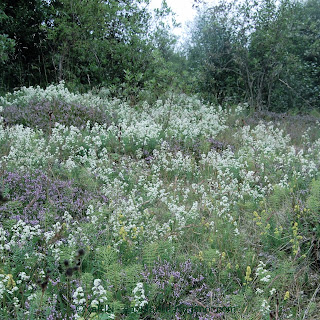
My own private paradise. This woodland is a 2 minute walk
from my house. There I can find most of the plants I write
about here. The rest I find around the allotment garden.
Looking at this list I am amazed at the variety of beneficial plants I am able to harvest from my immediate neighborhood.  And I left out Dandelion, Viola, Calendula and a few more.  You'd think I was living way out in the country, but I live in a very urban area.  I guess it is just a question of opening ones eyes to the possibilities that are around.

I am still learning about all the plants so that I can use them with confidence to treat minor ailments in the family.  I bought a thingy (on a whim on the internet) to stuff capsules and some capsules to stuff.  It works pretty well although I think my vintage glass turkey baster works best for getting the herb powder into the bigger capsules.  I think it makes sense to ingest the herbs that way.  Even if I have read about making tinctures and decoctions, it just sounds as a bit of a bother, although quite a bit more romantic.

But in the end I'm really thrilled with this abundance of goodies from nature and will now officially stop envying inhabitants of warmer climates for their plants. 
.

Sunday, August 8, 2010

Alkanet and eggshell

I love that little dish. It's not silver, I don't even know if it's
silver plated, but the design is just lovely. It's another one
dollar find at the Good S...
I used Alkenet in a soap the other day.  I have used it before with no great results.  It has turned beautifully blue as I add the lye to the oils, but during curing it has all but disappeared.  I now know that I need to use more of it than I have been doing.  I think I have only been putting a tablespoon or two into a batch of 5-800 g. / 17-28 oz which is my usual batch size, but I am not quite sure.  So this time I was careful to measure everything.

This time I figured that if I used yoghurt I should get a nice colour, since it is acid.  But just to make sure I had some lemon on hand to add to the soap as well.  The experience was really strange and I thought I was losing it when the whole thing turned a greeny-yellow with a blue frame around it.  I didn't take photo's of that because:
  1. I thought it looked really, really ugly  - and 
  2. I  was convinced that the soap would stay that way and I would get a chance to snap a photo should I develop a desire to do so.  
But instead it changed colour and first turned gray and then it started to turn lavender.  Not a strong purply lavender, but a soft shadowy kind.  So I haven't cracked the Alkanet mystery yet althought I like this soap.

The colour isn't perfect, in fact it looks better in the photo than it really is.  The white flecks in it are egg shell.  I read about that and had to try it.  I amassed a large quality of egg shells when I was baking for the wedding.  As I used the eggs I washed the shells out and let them dry.  Then I put them into a mortal and pounded with a pestle.  It was quite hard work to get them to be very small, but I got there in the end.  Now the thing that I read said that the egg shells would sink to the bottom and make a layer on the bottom, which I thought was quite a good idea.  But in this soap it didn't do that but is dispersed throughout the soap.  I think I will try this again and add the egg shell to a very thin soap to see if I can get it to sink to the bottom.  I think that is quite cool.

The recipe is for 500 g. of oils / 17.6 oz (the oz are approximate):

Olive oil            30% 150g / 5.3 oz
Coconut oil       25% 125g / 4.4 oz
Lard                  25% 125g / 4.4 oz
Sunflower oil    15%  75g /  0.9 oz  (60 g of this was Alkanet infused oil - I didn't have any more)
Cocoa butter      5%   25g / 2.4 oz

Yoghurt            38%  190g / 6.7 oz
Lye                              71g / 2.5 oz
5% SF.

I used frozen yoghurt for the water.  I dissolved the lye VERY slowly since I didn't want to burn the milk proteins in the heat.  The liquid turned a pretty yellow once I had dissolved the lye.  When I had added the liquid to the oils the whole thing turned a gray colour with blue around the edges and as I stirred the thing it turned this greeny-yellow.  At that point I added 2 tbs. of crushed egg shells and some lavender and bergamot EO.  I also added 1 tbsp. corn starch to see if I can get the scent to stay a little longer than usual.  I have just tried out the off cuts, a bit early, but it produced a nice lather and the egg shells were great for exfoliation.  But then again I can never find bath brushes that are scratchy enough, but it may not be to everyones liking.
.

Tuesday, August 3, 2010

Rhubarb soup with Rhubarb ice cream

Tivoli's rhubarb ice cream and rhubarb soup. Delicious.
Tivoli is a fun park in Copenhagen, Denmark.  It is a combination of fairground, shops and restaurants and every child's dream.  I was there for dinner in June and we got this amazing desert.  It was ice cold Rhubarb soup with some sort of dark chocolate/marzipan wafer and Rhubarb ice cream on top.  Not only did it taste good, but it looked really pretty so a snapped a photo of it.

When I came home I looked for recipes of Rhubarb soup and found a few.  This is the one I made and it is delicious.  Serve it ice cold (put it in the freezer for 10 minutes just before serving) with ice cream, either rhubarb or a good quality vanilla.  Any addition of dark chocolate in whatever form you can think of is a treat.  As is the mint leaves and berries.

Rhubarb soup (serves 4):
500 g rhubarb
200 g sugar
3 dl water
1 vanilla pod
Juice from one lemon if needed

Cut the rhubarb into small pieces.  Cut the vanilla pod into two and scrape off the vanilla corns into the sugar.  Put the water and sugar into a pot and bring to boil.  You can put the vanilla pod into the pot to simmer, but I put my pods in oil to use in creams and lotions.  Let simmer for 10 minutes.  Taste and adjust with more sugar or some lemon juice if needed.  Siv the rhubarb compot.  The liquid should be a pretty red soup.  Put the soup into the fridge.  It will keep well for a few days.   It can also be frozen for later use.  But serve it really, really cold with ice cream and decorate with a few mint leaves and redcurrants if you have them.  The left over rhubarb mush in the siv is lovely on toast for the next few days.

The view from our Paris apartment (ok, it's not ours, we rent
it, but we like to call it ours. With a view like that who can
blame us)
The best Rhubarb ice cream is sold in the ice cream shop on Île Saint-Louis in Paris.  It's on the corner opposite the rear end of Notre Dame, over the bridge.  And if you don't know it you'll recognize it by the long line.  But it's rare flavor to get in shops, so here is a recipe.  It is quite good and really easy to make.   I like the fact that it doesn't ask for all my egg yolks.  The trick is to use fairly small stalks and cut them into very small pieces.

Rhubarb ice cream:
300 g / 10.5 oz small cut rhubarb (that was about 5 stalks for me)
1 dl sugar / 3.4 oz
1/2 dl water / 1.9 oz water - if needed
3 dl / 10 oz whipping cream
2 egg yolks
1 tsp vanilla sugar (or essence)
1 tbs icing sugar

Cut the rhubarb into small pieces and put into a pot with the sugar and a little bit of water if needed.  Cook for a few minutes at low heat until the rhubarb is soft and mushy.  Take off the heat and let cool.  It doesn't take long, I took the dogs for a walk.

Mix the egg yolks with the icing sugar and vanilla.  Whip the cream and fold the yolk mixture into the cream.  Fold in the cooled rhubarb.  Put into an ice cream maker and follow instructions for that (mostly that you turn the icecreammaker on before you pour the mix into it) OR put into a bowl and stick it in the freezer.  If the latter, take out every now and again to stir through until frozen.  Stirring will prevent large crystals from forming.

My version of rhubarb ice cream and rhubarb soup with the
tuile cookie. The spoon is a Christmas spoon - a gift from
my stepmother in law and father in law.
I don't have recipe for a marizipanychocholateythingy but I made these, cause they looked kinda cute.

Tuiles:
80 g soft butter
80 g sugar
50 g flour
50 g glucose sirup

Mix together.  Smear it out on a baking sheet (I did four circles) and bake for ... well the recipe said "about 5 minutes at 175C /350F or until golden in colour"  That took about 20 minutes for me.  Now the rest of the instructions said: "Take the baking sheet out and wait a few minutes until it is cold enough to handle.  You can then make it into interesting shapes.  Let it cool completely and store in an airtight container."  This apparently works if you have Marthaesque composure in the kitchen.  I do not, so my instructions would be more along the lines of:  "You can make TRULY unique shapes while handling this gooey mess in a blind panic furiously trying not to burn off your fingers."

Bon appétit!
.

Sombre colours

I bought this fantastic linen yarn on a cone. It was quite fine and I usually like chunky yarns to knit.  But I love linen and this was a...